
Who gets to speak about the future? EMMIR student reflections from representing youth on global stages
By Yusril Nurhidayat (EMMIR Student Edition 13)
Reflections from the 2026 Yushan Forum in Taipei and European Youth Week 2026 in Brussels
Last semester, while pursuing my second EMMIR semester mobility in University of Stavanger, Norway, I was very grateful for the opportunities that led me to add 2 extra mobilities. I found myself in two places that could hardly have been more different in atmosphere, and yet were asking versions of the same question, that I am also carrying with me within my EMMIR journey.
The first extra mobility I had was to Taipei, Taiwan where I was invited by Taiwan’s Minister of Foreign Affairs and Taiwan-Asia Exchange Foundation to attend the ninth Yushan Forum on 16-17 March under the theme of “Indo-Pacific Partnership Prospects.” I was one of the few young people invited to represent youth communities in the region, and found myself sitting among head of states, ambassadors, ministers, and senior policy figures. Whereas the second additional mobility I had was to Brussels, Belgium, where I was invited by the European Parliament to attend the opening of European Youth Week 2026 on April 24 under the theme of “Solidarity and Fairness.”
The shared question I repeatedly encountered in both occasions, put plainly, was this: who is allowed to speak about the future, and on whose terms?

I attended both invitations as an Erasmus Mundus student in Migration and Intercultural Relations, but also as a young social anthropologist who has lived, studied, and worked in 21 countries, which is to say that I came trained to notice how a conversation is arranged before I notice what it concludes. My own research practice is arts-based and participatory. I work with Forum Theatre and participatory ethnography alongside communities navigating displacement and reconciliation, and that work has taught me to be attentive to the difference between being present and being consulted, and between being consulted and being believed.
Taipei: interculturality as method, not decoration
Representing youth in a forum organised around regional strategy is a particular kind of task. The vocabulary of the two days was one of supply chains, semiconductors, democratic solidarity and resilience, and my contribution was to argue that none of those hold without the intercultural infrastructure that makes cooperation possible in the first place.
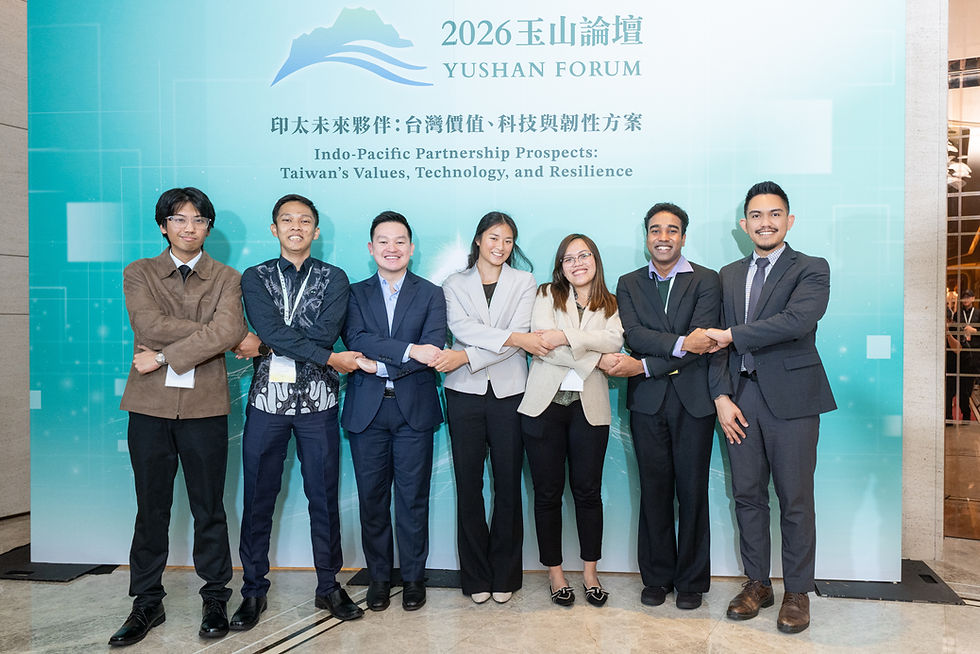
Much of what I said drew on leading STEAR, a youth-led think tank that connects young researchers across Europe and Asia, with over 1,000 members across 60 countries. Running a cross-continental organisation is an education in the unglamorous mechanics of cross-cultural collaboration: what it takes to hold a working group together across eight time zones, how differently the same policy vocabulary lands in Jakarta and in Vilnius, and how quickly a partnership becomes nominal when nobody has budgeted for the translation work, linguistic and cultural alike. Young people are already doing this work, largely without institutional support, and throughout Yushan Forum, I tried my best to amplify that and let the room hear it described as expertise rather than as enthusiasm.
From there I made the anthropological case. Interculturality is not a soft supplement to strategy. It is the condition under which strategy either takes hold in people's lives or fails to. What I pressed for was a people-centred approach to policy making, one that starts from how communities actually organise meaning, obligation and trust, rather than fitting them retrospectively into frameworks designed elsewhere.
The word resilience illustrated the point. In the plenary it described economies and infrastructures. In my own fieldwork it describes something quieter and more costly: households in Sayung, on the north coast of Central Java, who have raised their floors year after year against tidal inundation until raising them again stopped making sense. Both usages are legitimate. They are not interchangeable, and a regional strategy that borrows the language of endurance from communities on the coast without also borrowing their expertise will keep producing policy that is technically sound and socially thin.
Brussels: migration, and who counts as a European student
European Youth Week runs every second year, and the 2026 edition marked thirty years of volunteering in Europe. The opening day at the Parliament moved quickly from plenary into working sessions, and it was there that I was able to give input directly to the European Commissioner for Youth and Sport.

I brought migration perspectives, and specifically the position of migrant students in Europe. It is a position I occupy myself, as someone from Sulawesi studying on a mobility that already runs through Germany and Norway, and it is a position that European youth policy tends to address in the language of integration rather than of contribution. Migrant students are among the most practised intercultural workers on the continent. They navigate several administrative systems, several academic cultures and several languages as a matter of routine, and they are rarely asked what that competence might be good for beyond their own survival.
Much of the conversation turned to how institutions might better facilitate cross-cultural and multidisciplinary collaboration. My suggestions were concrete. Fund the connective work rather than only the events. Design mobility schemes that assume participants will bring knowledge into Europe as well as take it away. Bring disciplines into contact early, since the questions young people care about, climate displacement among them, do not divide neatly along faculty lines. And extend participation structures towards the communities people migrate from, which the current architecture barely reaches, less through oversight than through a failure of imagination.
Solidarity and fairness are generous words. In a European context they also have a border problem, and I said so.
What I am taking back into the programme
Two things, mainly.
The first is a renewed conviction that methodology is a political matter. Both forums used consultation formats that reward the articulate and the already fluent in institutional language. Arts-based and participatory methods are not a softer alternative to those formats. They are a way of widening who can enter a deliberation at all, and I intend to make that argument in my thesis rather than only in corridors.
The second is more practical. EMMIR is unusual in placing its students across regions rather than in a single national frame, and that turns out to be a real analytical advantage in rooms like these. I was able to move between an Indo-Pacific conversation and a European one and hear the repetitions. I would encourage colleagues in the programme to take up the delegate and participation places that come through our networks, and to arrive with something specific to say.
The stages are global. The obligation, as far as I can see it, remains local.


The best game for a particular moment depends on what the player wants to accomplish. CoolGamesFree offers Trending Games for moments when you want competition, relaxation, experimentation, or simply something entertaining to do for a few minutes.